Skip to content


Two centimeters is a tiny length. Yet people look it up all the time. Maybe you are filling out a form. Maybe you are cutting fabric, buying a part, or reading a doctor’s note.
This guide gives you the answer fast. Then it shows you how to see 2 centimeters on a ruler, convert it to other units, and spot it in everyday objects. You will also find clear answers to common questions, from “2 centimeters dilated” to “2 centimeters per second.”
2 Centimeters at a Glance
Here is the short answer. Two centimeters equals 0.787 inches. That is 20 millimeters, or 0.02 meters.
| Unit | Value for 2 cm |
|---|---|
| Inches | 0.787 in |
| Millimeters | 20 mm |
| Meters | 0.02 m |
| Feet | 0.0656 ft |
| Fraction of an inch | About 25/32 in (13/16 in rounded) |
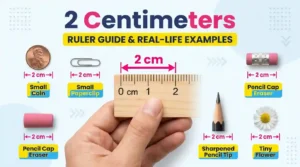
Think of it as a bit less than an inch. It is about the width of a US nickel. It is also close to the width of an adult thumb.
How Long Is 2 Centimeters?
Two centimeters is a short metric length. You can fit about five of them across the palm of a hand. You can fit only a little more than one of them inside a single inch.
A good way to picture it is to look at your thumb. Many adults have a thumb that is about 2 cm to 2.5 cm wide at the top joint. That makes your thumb a handy guide when no ruler is nearby.
What a Centimeter Means
A centimeter is one hundredth of a meter. The prefix “centi” means one hundredth, so 100 cm make 1 meter. The meter is the base unit of length in the International System of Units, known as SI. SI grew out of the metric system, which began in France in the 1790s.
A centimeter is also made of 10 millimeters. This is why 2 cm equals 20 mm. The metric system works in tens, so the math is easy once you know the pattern.
What Size Is 2 cm?
Two centimeters is a small size. It is 20 millimeters long, which is about three quarters of an inch. It is shorter than most coins in your pocket, but it is easy to see.
What Does 2 cm Look Like?
Numbers can feel abstract, so compare 2 cm with things you know:
- It is smaller than a US quarter, which is about 24 mm wide.
- It is close to a US nickel, which is about 21 mm wide.
- It is a little wider than a US penny, which is about 19 mm wide.
- It is nearly three times the width of a standard pencil, which is about 7 mm.
Most people say 2 cm looks smaller than they expected. Small sizes are hard to judge by eye.
What Does 2 cm Look Like in Inches?
In inches, 2 cm looks like a little less than one inch. Picture an inch on a ruler. Then picture a line that stops about one fifth short of it. That is 2 cm, or 0.787 inches.
How Many Fingers Is 2 Centimeters?
For most adults, 2 cm is about one finger wide. Your thumb is usually the closest match. Children have narrower fingers, so two of their fingers may fit in 2 cm. Finger size varies, so check yours with a ruler once.
2 Centimeters to Inches
Most people searching for this want one answer. How many inches is 2 centimeters? The answer is 0.787 inches. You can round it to 0.79 inches for daily use.
The Conversion Formula
One inch equals exactly 2.54 centimeters. In 1959, several English-speaking countries, including the United States and the United Kingdom, agreed to define the inch as exactly 2.54 centimeters. That agreement is why the number never changes. To change centimeters to inches, divide by 2.54.
Inches = centimeters ÷ 2.54
For 2 cm, the math looks like this:
2 ÷ 2.54 = 0.7874 inches
You can also multiply by 0.3937. Both methods give the same result.
Step-by-Step Example
- Write down the length in centimeters: 2 cm.
- Divide it by 2.54.
- Read the result on your calculator: 0.7874.
- Round to the number of places you need.
If you need two decimal places, write 0.79 in. If you need three, write 0.787 in. For a quick estimate, say “just under 0.8 inches.”
Is 2 Centimeters an Inch?
No. Two centimeters is not an inch. One inch is 2.54 cm. So 2 cm falls short of a full inch by about 0.54 cm, which is just over 5 mm.
Put another way, 2 cm is about 79% of an inch. Many people mix these up because both units are small. The gap is easy to see on a ruler. The 2 cm mark sits well before the 1 inch mark.
2 Centimeters as a Fraction of an Inch
Tape measures and many tools use fractions, not decimals. Here is how 2 cm fits in:
- In 8ths: about 6/8 in, which is 3/4 in. This is slightly too short.
- In 16ths: 13/16 in. This is the closest 16th, but it is slightly long.
- In 32nds: 25/32 in. This is very close to the real value.
For woodworking or sewing, 13/16 inch is usually fine. For precise work, use 25/32 inch or measure in millimeters.
A Quick Mental Trick
Divide the centimeters by 2.5 for a close answer in inches. So 2 ÷ 2.5 = 0.8 inches. That is good enough for most tasks.
2 Centimeters in Other Units
Sometimes you need a unit other than inches. The table below covers the most common ones.
| Unit | 2 centimeters equals |
|---|---|
| Millimeters | 20 mm |
| Meters | 0.02 m |
| Kilometers | 0.00002 km |
| Inches | 0.7874 in |
| Feet | 0.0656 ft |
| Yards | 0.0219 yd |
| Micrometers | 20,000 µm |
2 Centimeters to Millimeters
To change centimeters to millimeters, multiply by 10. So 2 cm to mm is 2 × 10 = 20 mm. On a ruler, you count 20 small lines from zero.
2 Centimeters to Meters
To change centimeters to meters, divide by 100. So 2 cm is 2 ÷ 100 = 0.02 m. This is how many meters 2 centimeters make. It is two hundredths of a meter.
What Is 2 cm in Feet?
To change centimeters to feet, divide by 30.48. One foot has 30.48 cm. So 2 cm in feet is 2 ÷ 30.48 = 0.0656 ft. Feet are a poor unit for such a small length. Inches or millimeters work better.
2 Centimeters in Pixels
Designers and web editors often need pixels. The answer depends on the resolution, which is measured in DPI (dots per inch). First change centimeters to inches. Then multiply by the DPI.
| Resolution | 2 cm in pixels |
|---|---|
| 72 DPI | About 57 px |
| 96 DPI | About 76 px |
| 300 DPI (print) | About 236 px |
For print work, use 300 DPI. For most screens, 96 DPI is the standard reference. Keep in mind that a real screen may not show 2 cm at true size. Pixel density changes from one device to the next.
Using a Spreadsheet to Convert
Excel and Google Sheets have a built-in tool. Type this in a cell:
=CONVERT(2,”cm”,”in”)
The cell will show 0.787401575. Change “in” to “mm”, “m” or “ft” to get other units. This helps when you have a long list of values.
2 Centimeters on a Ruler
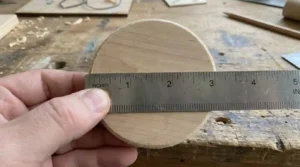
A ruler is the best tool for seeing 2 cm. Most school rulers show centimeters on one edge and inches on the other. Check which side you are reading before you start.

Finding 2 cm on the Metric Side
Start at the zero mark. Move right past the number 1. Stop at the number 2. That line is 2 cm.
Between each number, you will see 10 small lines. Each small line is 1 mm. So the 2 cm mark is 20 small lines from zero.
Finding 2 cm on the Inch Side
If you only have an inch ruler, use fractions. The 2 cm mark falls between 3/4 inch and 13/16 inch. It is a little past the 3/4 inch line. The 1 inch line is farther to the right.
This is also the answer to “2 centimeters to inches on a ruler.” Look just past the 3/4 mark. That spot is 2 cm.
Tips for Reading a Ruler Correctly
- Line up the zero mark with the start of the object. Do not use the edge of the ruler unless the zero sits there.
- Look straight down at the ruler. Viewing from the side shifts the reading.
- Read the metric side for centimeters. Do not mix the two scales.
Can You Use a Printed Ruler?
People often search for a 2 cm picture to see the true size. An image on a screen rarely shows it exactly. A printed page is better. If you print a ruler, you can check it with a coin.
Print with care. If you print a ruler, set the print scale to 100%. Do not choose “fit to page.” Then measure a known item, such as a coin, to check it. A US nickel should measure about 21 mm on your printout.
2 Centimeters Compared With Other Small Lengths
It helps to compare 2 cm with nearby sizes. People often mix up 2 mm, 2 cm and 2 inches. They are very different.
| Length | In centimeters | In inches |
|---|---|---|
| 2 millimeters | 0.2 cm | 0.079 in |
| 2 centimeters | 2 cm | 0.787 in |
| 2 inches | 5.08 cm | 2 in |
| 2 decimeters | 20 cm | 7.874 in |
Two inches is more than twice as long as 2 cm. Two millimeters is ten times shorter. Always check the unit symbol. One small letter changes the size a lot.
Centimeters to Inches for 1 to 10 cm
If you work with several small lengths, a short table saves time.
| Centimeters | Inches |
|---|---|
| 1 cm | 0.394 in |
| 2 cm | 0.787 in |
| 3 cm | 1.181 in |
| 4 cm | 1.575 in |
| 5 cm | 1.969 in |
| 6 cm | 2.362 in |
| 7 cm | 2.756 in |
| 8 cm | 3.150 in |
| 9 cm | 3.543 in |
| 10 cm | 3.937 in |
Notice the pattern. Each extra centimeter adds about 0.394 inches. So you can build any value by adding steps.
How Exact Do You Need to Be?
The right level of detail depends on the task. A school worksheet may ask for two decimal places. A sewing pattern may only need the nearest quarter inch. A machine part may need a tolerance of a fraction of a millimeter.
Here is a simple guide:
- For rough estimates, use 0.8 inches.
- For daily tasks, use 0.79 inches.
- For woodworking, use 25/32 inch or 13/16 inch.
- For technical work, use 20 mm and skip the inch conversion.
Everyday Objects That Are About 2 Centimeters
Real objects help you remember the size. Here are items close to 2 cm.
| Object | Approximate size |
|---|---|
| US nickel (5 cents) | 21 mm across |
| US penny | 19 mm across |
| Euro 5-cent coin | 21 mm across |
| Euro 10-cent coin | 20 mm across |
| UK 1 penny coin | 20 mm across |
| Small binder clip | 19 mm wide |
| Keyboard key spacing | 19.05 mm |
| Two AAA batteries side by side | About 21 mm |
| Three standard pencils side by side | About 21 mm |
| Size 1 capsule (closed) | About 19 mm long |
| Shirt cuff button | 18 to 20 mm across |
| Sugar cube | 1.5 to 2 cm per side |
| Large grape | 2 to 2.5 cm long |
| Cherry tomato | 2 to 3 cm across |
Coins Are the Most Reliable Guide
Coins have set sizes. This makes them better than fruit or fingers. If you carry change, you carry a ruler. A US nickel, a euro 5-cent coin and a euro 10-cent coin are all within a millimeter of 2 cm.
Office and Desk Items
Your desk holds good references too. A small binder clip is sold as a 19 mm clip. Keyboard keys are spaced 19.05 mm apart, a standard known as 1u. That spacing is measured from the center of one key to the next. So it is not the width of the key itself, but it gives you a close feel for 2 cm.
You can also stack things. A compact disc is about 1.2 mm thick, so 16 discs make roughly 2 cm. Half of a golf ball, which is 42.67 mm wide, is also close.
Food and Health Items
Food varies by type and season. A sugar cube, a large grape and a small cherry tomato often come near 2 cm. Use them for a rough idea only.
Supplement capsules are more consistent. A size 1 capsule is about 19 mm long when closed. A typical shirt cuff button is also near 2 cm.
How to Measure 2 Centimeters Without a Ruler
You may not always have a ruler. These ideas can help you find 2 cm.
- Use a coin. Place a US nickel or a euro 5-cent coin flat on the object. Its width is about 2 cm.
- Use paper. A sheet of A4 paper is 21 cm wide. Fold it into ten equal parts, and each part is 2.1 cm. This is close.
- Use a measuring tape. Tapes show both units. The 2 cm mark is just before the 1 inch line.
- Use your thumb. Check it against a ruler first so you know your own size.
These tricks are good for rough work. If an item needs an exact fit, buy or borrow a ruler or caliper.
Where People Use 2 Centimeters
A small length shows up in many places. Here are the most common ones.

Sewing and Crafts
Patterns often use metric seam allowances. A 1.5 cm allowance is common. A 2 cm hem is also common for light fabric. If your pattern is in inches, 2 cm is close to 3/4 inch.
Buttons, ribbon widths and beads often come in sizes near 2 cm. Knowing the inch value helps when a shop lists sizes in only one unit.
Home Repair and DIY
Gaps, trims and spacers are often measured in centimeters. A 2 cm gap is big enough to fit a finger tip. It can matter for door clearance, tile spacing and cable holes.
Screws and bolts are often sold in millimeters. A 20 mm screw is about 0.79 inches long. That is close to 3/4 inch, which is 19.05 mm. The two are not always interchangeable, but they are close.
Jewelry and Ring Sizes
Small lengths matter in jewelry. A ring with an inner diameter of 2 cm has an inner circumference of about 62.8 mm. That is roughly a US size 10. Size charts differ by country and brand, so check the chart before you buy.
Earrings and pendants near 2 cm look small and delicate. They sit about as wide as a US nickel.
Standard 20 mm Sizes
Some products are made to a 20 mm standard. Watch straps are a good example. A 20 mm strap is one of the most common sizes. The number refers to the gap between the lugs where the strap attaches. So a “20 mm watch strap” is 2 cm wide.
Water pipes also come in 20 mm sizes in many countries that use metric units. Pipe sizes are often nominal, so the true outer diameter can differ a little. Check the label before you buy fittings.
Shopping
Product listings often show sizes in centimeters. A 2 cm pendant is small. A 2 cm thick phone case is bulky.
Weather and Rainfall
Rain is measured in millimeters or centimeters. A rainfall of 2 cm is 20 mm. One millimeter of rain equals one liter of water on one square meter. So 20 mm of rain puts 20 liters on each square meter.
Maps and Scale Drawings
Map scales link centimeters on paper to real distance. At a scale of 1:50,000, 2 cm on the map is 1 km on the ground. At 1:25,000, it is 500 meters.
To find the real distance, multiply the map length by the scale number. Then change the result to meters or kilometers.
School and Science
Teachers use short lengths in unit conversion lessons. Plant growth is often measured this way. A growth of 2 cm in a week is easy to see on a ruler.
What Does “2 Centimeters Dilated” Mean?
This is one of the most common searches that include 2 cm. It does not describe an object. It describes the cervix during pregnancy.
How Cervical Dilation Is Measured
The cervix is the lower part of the uterus. Before labor, it stays closed. Over time, it opens, or dilates, so a baby can pass through.
Providers measure dilation in centimeters. The scale runs from 0 to 10 cm. At 10 cm, the cervix is fully open. That is about 3.9 inches.
What 2 Centimeters Dilated Means
Being 2 centimeters dilated means the cervix has opened a little. It is about 0.8 inches wide, or the width of a US nickel. It often marks the start of the latent phase, the slow early stage of labor. The body is starting to prepare, but active labor is not yet under way.
Here is the key point. Two centimeters does not tell you when labor will begin. Some people stay at 2 cm for days or even weeks. Others move from 2 cm to active labor in a few hours. This is common, especially in people who have given birth before.
The American College of Obstetricians and Gynecologists (ACOG) describes the first stage of labor as the time from the start of labor until the cervix is 10 cm dilated. ACOG splits this stage in two. The latent phase lasts until 6 cm, and active labor begins at 6 cm. Until then, labor may be slow and uneven.
2 Centimeters Dilated at 36 Weeks
Full term starts at 37 weeks. So 36 weeks is slightly early. Finding that you are 2 cm dilated at 36 weeks can be normal. The cervix can open a little without regular contractions.
Dilation alone does not predict early birth. Your provider looks at other things too. These include contractions, cervical length, baby movement and your health history.
When to Call Your Provider
Contact your doctor or midwife right away if you notice any of these signs before 37 weeks:
- Regular contractions that get stronger or closer together
- Fluid leaking or a gush of water
- Vaginal bleeding
- Less baby movement than usual
- Strong pelvic pressure or back pain that does not ease
At full term, many providers suggest calling when contractions are about five minutes apart, last about one minute, and continue for an hour. Ask your own provider what plan they want you to follow.
What Else Matters Besides Dilation
Dilation is only one measure. Providers also check effacement, which is how thin the cervix has become. They also check the baby’s position. A cervix can be 2 cm dilated and still be thick and firm. Or it can be thin and soft. Each case is different.
This section is general information. It cannot replace advice from your own provider.
2 Centimeters in Medical Measurements
Doctors often describe sizes in centimeters. You may see 2 cm in a scan report or a clinic note. It might describe a cyst, a nodule, a scar, a bruise or a swelling.
A size of 2 cm is about 0.8 inches. A 2 cm cyst, for example, is about the size of a large grape. Alone, that number does not tell you if something is serious. The type, location, shape and changes over time matter more. Doctors compare earlier and later scans to see if a size has grown.
If you read a report that lists a size, ask your provider what it means for you. Write down your questions before the visit. Ask whether the size is expected, and whether a follow-up is needed.
2 Centimeters per Second
Speed questions also use 2 cm. A speed of 2 centimeters per second (cm/s) is very slow.
Here is how it converts:
| Unit | 2 cm/s equals |
|---|---|
| Meters per second | 0.02 m/s |
| Meters per minute | 1.2 m/min |
| Meters per hour | 72 m/h |
| Kilometers per hour | 0.072 km/h |
| Miles per hour | About 0.045 mph |
| Inches per second | 0.787 in/s |
At this speed, an object takes 50 seconds to move one meter. A garden snail moves at roughly this order of speed or slower. A person walking moves about 100 times faster.
2 Centimeters and Height
Some people search for “2 centimeters height” when they compare heights. A 2 cm difference is small. It is about 0.8 inches.

Your height also changes during the day. Many people are slightly taller in the morning than at night. The difference can reach 1 to 2 cm. This happens because the spine compresses a little through the day. So a 2 cm gap between two measurements may be normal.
If you are comparing heights, measure at the same time of day. Stand straight against a wall. Keep your feet flat and your head level.
Related Conversions
Many people who look up 2 cm also need other conversions. Here are the most common ones.
2 Inches to Centimeters
To go the other way, multiply inches by 2.54. If you are converting 2 in inches to cm, the answer is 2 × 2.54, so 2 inches equals 2 × 2.54 = 5.08 cm. This is more than twice the length of 2 cm.
Centimeters to Inches: 20 to 28 cm
Use the same formula for larger values. Divide by 2.54.
| Centimeters | Inches |
|---|---|
| 20 cm | 7.874 in |
| 21 cm | 8.268 in |
| 22 cm | 8.661 in |
| 23 cm | 9.055 in |
| 24 cm | 9.449 in |
| 25 cm | 9.843 in |
| 26 cm | 10.236 in |
| 27 cm | 10.630 in |
| 28 cm | 11.024 in |
Feet and Inches to Centimeters
Height is often given in feet and inches. To convert, change the whole height to inches first. Then multiply by 2.54.
- 5’2″ is 62 inches, which equals 157.5 cm.
- 6’2″ is 74 inches, which equals 188 cm.
Search phrases such as “5 foot 2 in centimeters” and “6 foot 2 in centimeters” point to this kind of conversion. A person who is 6’2″ is about 30.5 cm taller than someone who is 5’2″.
The 2.54 Rule
The number 2.54 is the link between the two systems. One inch is exactly 2.54 centimeters. So 2.54 centimeters is one inch. Remember this number, and you can convert any length in your head with a little practice.
Common Mistakes to Avoid
Small errors can add up. Watch for these.
Mixing Up Centimeters and Millimeters
A centimeter is ten times longer than a millimeter. A part that is 2 cm is not 2 mm. Always check the unit before you cut, order or print.
Reading the Wrong Side of the Ruler
Many rulers have two scales. If you read inches while you mean centimeters, the answer is wrong. Look at the label near the numbers. It will say “cm” or “in.”
Confusing Length with Area or Volume
A length of 2 cm is different from 2 cm². A square that is 2 cm on each side has an area of 4 cm². A cube that is 2 cm on each side has a volume of 8 cm³, which equals 8 milliliters. Make sure the unit matches what you want to measure.
Frequently Asked Questions
Two centimeters is about 0.79 inches, or 20 millimeters. It is close to the width of a US nickel and about the width of an adult thumb.
Two centimeters is 0.787 inches, or about 0.79 inches. It is a little less than one inch.
It is about one adult finger or thumb wide. Check your own finger with a ruler to be sure.
On a metric ruler, find the number 2 and read the line next to it. That line is 2 cm. On an inch ruler, it falls just past the 3/4 inch mark.
Two centimeters is 20 millimeters. Multiply the centimeters by 10 to get millimeters.
Two centimeters is 0.02 meters. Divide the centimeters by 100 to get meters.
It depends on the resolution. At 96 DPI, 2 cm is about 76 pixels. At 300 DPI, it is about 236 pixels.
Two inches is 5.08 cm, so it is more than twice as long as 2 cm. Always check the unit before you measure or order.
Only for a rough guess. Screens vary, and ruler apps can be off by a few millimeters. A printed ruler at 100% scale or a real ruler is more reliable.
Yes. An inch is 2.54 cm, so 2 cm is smaller. It is about 79% of an inch.
Two centimeters is 0.0656 feet. Divide by 30.48 to find this. Feet are rarely used for such a small length.
It means the cervix has opened about 0.8 inches. This is an early stage of dilation. It does not show when labor will start. Some people stay at 2 cm for days or weeks.
Final Thoughts
Two centimeters is 20 millimeters, 0.02 meters or about 0.79 inches. It is a bit shorter than an inch. A US nickel or a euro 5-cent coin gives you a quick visual guide.
To convert, divide centimeters by 2.54 for inches. Multiply by 10 for millimeters. Divide by 100 for meters. On a ruler, find the number 2 on the metric side, or look just past 3/4 inch on the inch side.
Whether you sew, build, shop or read a medical note, you now know how big 2 centimeters really is. Keep the 2.54 rule in mind, and you can handle most length conversions with confidence.

Andrew Brooks writes clear and practical measurement content covering inches, feet, centimeters, millimeters, meters, dimensions, and everyday size comparisons. He focuses on making measurements easy to understand through simple explanations, useful examples, and practical comparisons.