Skip to content


If you’ve ever wondered how big 1 inch is but had no ruler or tape measure nearby, you’re not alone. The inch is one of the most common units of length in the United States, and it’s surprisingly easy to misjudge by eye. This guide shows what 1 inch looks like, how it compares to everyday objects and your own fingers, how to convert it into metric and other units, and where this small unit came from.
How Big Is 1 Inch Exactly?
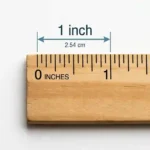
One inch equals exactly 2.54 centimeters or 25.4 millimeters. It is also 1/12 of a foot and 1/36 of a yard, so 12 inches make 1 foot and 36 inches make 1 yard.
The inch belongs to the Imperial and US Customary systems of measurement. The United States uses it daily, while the United Kingdom and Canada use it alongside metric. Most of the world relies on the metric system. The exact inch-to-metric relationship is recognized by standards bodies such as NIST in the United States, and the metric system itself is maintained by the International Bureau of Weights and Measures (BIPM).
What Is 1 Inch in cm, mm and Other Units?
Here are the conversions people look up most often:
| Unit | Equal to 1 inch |
|---|---|
| Centimeters (cm) | 2.54 cm |
| Millimeters (mm) | 25.4 mm |
| Meters (m) | 0.0254 m |
| Feet | 0.0833 ft |
| Yards | 0.0278 yd |
| Points | 72 pt |
| Picas | 6 picas |

How Big Is 1 Inch in cm?
In centimeters, 1 inch is exactly 2.54 cm. That means a 10 cm line is just under 4 inches long, and a 30 cm ruler is about 11.8 inches.
How Big Is 1 Inch in mm (Millimeters)?
If you type 1inch in mm into a search bar, the answer is 25.4 mm. Put another way, how big is 1 inch in millimeters? A little over 25 of them. This is the number to use for engineering drawings, 3D printing and any work where you need precision.
How Much Is 1 Inch in m?
In meters, 1 inch is 0.0254 m. It’s a small decimal, which is why centimeters and millimeters are more practical for most everyday measuring.
How to Convert 1 Inch to Feet
To go from inches to feet, divide by 12. So 1 inch to feet is 1/12, or about 0.0833 ft. In the other direction, multiply feet by 12, so 3 feet is 36 inches.
How to Convert Feet and Inches (Like 5′ 6″) to Inches and cm
Heights are usually written in feet and inches. To convert, multiply the feet by 12 and add the leftover inches. For 5′ 6″, that is 5 × 12 + 6 = 66 inches. Multiply by 2.54 and you get 167.64 cm. The same method shows that 6′ 0″ is 72 inches, or 182.88 cm.
How to Convert Inches to Centimeters (and Back)
The formula is simple, and 2.54 is an exact number, not a rounded one.
- Inches to centimeters: multiply by 2.54. For example, 5 inches × 2.54 = 12.7 cm.
- Centimeters to inches: divide by 2.54. For example, 30 cm ÷ 2.54 = about 11.81 inches.
- Inches to millimeters: multiply by 25.4. For example, 3 inches × 25.4 = 76.2 mm.
For a quick mental estimate, remember that 1 inch is a little over 2.5 cm and a little over 25 mm. Use the exact figure for anything that needs precision.
What Does 1 Inch Look Like? Everyday Objects That Help
What Common Object Is 1 Inch?
The best everyday example is a hockey puck. A regulation puck is exactly 1 inch thick, which makes it one of the few common objects with a precise inch built in.
What Object Is 1 Inch Long?
When you have no ruler, these familiar items give you a reliable mental picture:
- A US quarter. It measures about 0.955 inches across, so it’s close but slightly under. The golden dollar coin is about 1.04 inches, so it’s the nearer match if you have one.
- A standard wine cork. A typical cork is about 0.94 inches across, just under a full inch.
- A bottle cap. The cap on a plastic water bottle is close to 1 inch in diameter.
- A shooter marble. The large marble used to knock others out of the ring is around an inch wide.
- Masking tape. A standard roll is often 1 inch wide, which is why painters use it as a quick edge guide.
- A 1-inch wood screw. This is among the most common sizes in any hardware aisle.
- A large paper clip. Roughly an inch in length.
- A standard gaming die. Each side is close to 1 inch.
- An SD memory card. The wide edge is 24 mm, or about 0.94 inches.
- A stack of pennies. Each penny is about 1.52 mm thick, so around 17 stacked together reach 1 inch.

These sizes vary slightly by brand and manufacturer, so treat them as estimates. For woodworking, sewing, tailoring or engineering drawings, always measure with a proper ruler or tape measure.
How Big Is an Inch with Your Fingers?
Your hand is a measuring tool you always carry. For many adults, the width of the thumb, or the distance from the tip of the index finger to the first knuckle, is close to 1 inch.
So how big is 1 inch compared to a finger? For most people it’s roughly one finger segment or one thumb width, but hand sizes differ. If you’re asking how big 1 inch is on a finger, the safest approach is to check your own thumb against a ruler once. After that, you have a quick personal reference for shopping, crafts or DIY projects.

How Big Is One Inch Visually on a Screen?
If you want to see how big one inch is visually on a phone or monitor, the answer depends on the display. An inch is not a fixed number of pixels. In CSS, the standard language for styling web pages, 1 inch is defined as 96 pixels. For print-quality images at 300 DPI, it equals 300 pixels, and older defaults use 72 pixels.
Designers also use PPI (pixels per inch) for screens and DPI (dots per inch) for printers. The two terms are often used interchangeably, but PPI describes the pixel density of a display while DPI describes the ink dots a printer lays down.
Because screens vary in size and resolution, an on-screen ruler is only accurate if it has been calibrated to your display. The simplest check is to hold a real ruler against the glass. If you need a life-size ruler on paper, print it at 100% scale with “fit to page” turned off, then measure the printed inch with an actual ruler to confirm it came out right.
1 Inch in Points and Picas
Typography has its own units. In desktop publishing, 1 inch equals 72 points, and 1 pica equals 12 points, so 1 inch is also 6 picas. This is why font sizes are given in points and why print layouts often mix inches, points and picas.
How Big Is 1 Inch in Height?
When people ask how big 1 inch is in height, they usually want to picture something 1 inch tall. A few easy references:
- A regulation hockey puck stands exactly 1 inch tall.
- A stack of about 17 pennies reaches roughly 1 inch.
- A low shoe platform or heel lift of 1 inch is a small but noticeable difference.
- A trim of 1 inch of hair removes about two months of growth.
In centimeters, a 1 inch height is 2.54 cm, and it takes 12 of them to reach a foot.
What Is the Symbol for 1 Inch?
The 1 inch symbol is the double prime mark ″, and the abbreviation is in. You will often see it typed with a straight double quote, so 1 inch can appear as 1 in, 1″ or 1″. In technical drawings and product specs, the symbol is common because it saves space, for example a 1″ pipe or a 27″ monitor. A single prime (′) is used for feet, so 5′ 6″ means 5 feet 6 inches.
How to Read 1 Inch on a Ruler
On a ruler or tape measure, the longest numbered line closest to the zero edge marks 1 inch. If the ruler starts at zero on its left edge, the first tall number “1” is a full inch from that edge. Some rulers have a small blank gap before the zero line, so always start counting from the zero mark, not the physical end.
The shorter ticks between the numbers divide each inch into fractions. Here is what those fractions equal in metric:
| Fraction of an inch | Decimal inch | Millimeters | Centimeters |
|---|---|---|---|
| 1/16 inch | 0.0625 | 1.59 mm | 0.16 cm |
| 1/8 inch | 0.125 | 3.18 mm | 0.32 cm |
| 1/4 inch | 0.25 | 6.35 mm | 0.64 cm |
| 3/8 inch | 0.375 | 9.53 mm | 0.95 cm |
| 1/2 inch | 0.5 | 12.7 mm | 1.27 cm |
| 3/4 inch | 0.75 | 19.05 mm | 1.91 cm |
| 1 inch | 1 | 25.4 mm | 2.54 cm |

How to Turn a Decimal Inch into a Fraction
Digital calipers and online tools often show decimals, while rulers show fractions. To convert, multiply the decimal part by 16 and read the result as sixteenths. For example, 0.375 × 16 = 6, so 0.375 inch is 6/16, which simplifies to 3/8 inch. The table above gives the most common matches.
How Big Is 1 Inch Compared to Larger Measurements?
Once you can picture 1 inch, scaling up is easy:
| Inches | Centimeters | Notes |
|---|---|---|
| 2 inches | 5.08 cm | |
| 3 inches | 7.62 cm | Diameter of a hockey puck |
| 4 inches | 10.16 cm | |
| 6 inches | 15.24 cm | Half a foot |
| 8 inches | 20.32 cm | |
| 12 inches | 30.48 cm | 1 foot |
| 36 inches | 91.44 cm | 1 yard |
Where Does the Inch Come From?
The word “inch” traces back to the Latin uncia, meaning one twelfth, which also explains why there are 12 inches in a foot. In medieval England, the inch was loosely tied to the width of a thumb. A statute attributed to the reign of Edward II, around 1324, described it as the length of three barleycorns, round and dry, laid end to end.
The modern inch is much more precise. Under the 1959 international yard and pound agreement, the United States, the United Kingdom and other Commonwealth nations, including Canada, Australia and South Africa, agreed to define the yard as exactly 0.9144 meters. That fixed the inch at exactly 25.4 millimeters. Before this, the American and British inches differed by a very tiny amount, so the agreement removed a quiet source of error in trade and manufacturing.
One side effect is the US survey foot, a slightly different foot used for decades in land surveying in the United States. It differs from the international foot by about two parts per million, and it was retired at the end of 2022 so that everything now uses the international standard. The inch itself was never affected.
How Big Is 1 Inch of Hail?
Weather reports often describe hail by size. One-inch hail is about the size of a US quarter, and the National Weather Service uses 1 inch as the threshold for severe hail. Hail of this size can dent cars and damage roofs, gardens and crops.
What Does 1 Inch of Rain Mean?
One inch of rain means the depth of water that would collect on a flat surface if none of it drained or soaked in. Rainfall totals in United States forecasts are given in inches. Over a single acre, 1 inch equals about 27,154 gallons of water. It sounds gentle, but a steady inch of rain can fill gutters and flood low ground quickly.
How Big Is a 1 Inch Tattoo?
A 1 inch tattoo is roughly the width of a quarter, which suits minimalist designs like a small symbol, initial or simple line drawing. Very fine detail can blur over time at this size, so it’s worth asking your tattoo artist whether your design will stay clear when scaled down.
How Big Is 1 Inch of Hair?
Hair grows about half an inch per month on average, so 1 inch of hair represents roughly two months of growth. This is why a trim of “just an inch” can feel like a bigger change than expected.
What Does a “1 Inch Sensor” Mean on a Camera?
This one surprises people. If you’re wondering how big a 1 inch sensor is, it does not measure 1 inch across. The name comes from an old naming convention for video camera tubes, and the actual sensor is about 13.2 mm by 8.8 mm. It’s a label, not a true measurement.
How Big Is a 1 Inch Diameter?
A 1 inch diameter is the distance straight across a circle through its center, which is 2.54 cm. This applies to pipes, rods, bolts and circular objects. The circumference of a 1 inch diameter circle is about 3.14 inches.
Nominal Size vs Actual Size: When “1 Inch” Isn’t 1 Inch
The 1 inch sensor is not the only case where a label differs from reality. Many products use a nominal size, which is a convenient name rather than an exact measurement:
- Pipes: a 1 inch nominal pipe has an outside diameter of about 1.315 inches.
- Lumber: a 2×4 board actually measures about 1.5 by 3.5 inches, and a 1×4 is about 3/4 by 3.5 inches.
- Screens: a TV or monitor size is the diagonal of the display, not its width or height.
When precision matters, check the manufacturer’s actual dimensions instead of trusting the label.
Where Is 1 Inch Used in Daily Life?
You meet this measurement more often than you might expect: picture frames, furniture dimensions, tiles, belt widths, ribbon, binder rings, nails and screws, and the display sizes of phones, TVs and laptops. A “1-inch binder” refers to the ring size, which holds roughly 175 to 200 sheets.
Common Mistakes When Measuring 1 Inch
- Using 2.5 instead of 2.54. The error is small for one inch but adds up over longer lengths.
- Treating a quarter as exactly 1 inch. It’s about 0.955 inches, so it is only an estimate.
- Measuring from the end of the ruler. Start from the zero line, which may sit slightly in from the edge.
- Trusting printed or on-screen rulers. Scaling can shrink or stretch the inch, so verify against a real ruler.
- Mixing up nominal and actual sizes. A “1 inch” pipe or a 2×4 board does not measure what the name suggests.
Quick Tips for Measuring 1 Inch Without a Ruler
- Use your thumb. Check its width once against a ruler.
- Carry a reference coin. A quarter or dollar coin in your pocket is a handy guide.
- Fold paper. Folding a sheet into even sections gives you rough inch-sized steps.
- Use your phone. Many smartphones are around 2.5 to 3 inches wide, so one-third of the width is close to an inch.
- Verify with a tape measure. Printed rulers and templates can shift slightly when scaled, so double-check important measurements.
Frequently Asked Questions
Think of a hockey puck’s thickness, a wine cork, a bottle cap or the width of your thumb. All are close to 1 inch.
Not exactly. 1 inch is exactly 2.54 cm. Using 2.5 gives a small error that grows as the length increases.
There are exactly 25.4 millimeters in 1 inch.
No. A US quarter is about 0.955 inches across, so it is slightly under an inch. It works well for estimates but not for precise measuring.
There are 12 inches in a foot and 36 inches in a yard.
There are 72 points in an inch in desktop publishing, and 6 picas.
The name comes from the size of old video camera tubes, not the sensor’s real dimensions. A 1-inch sensor measures about 13.2 mm by 8.8 mm.
The symbol is ″ (double prime), often typed as “. The abbreviation “in” is also used.
Related Guides
Once you’re comfortable with 1 inch, these topics build on the same ideas:
- How big is 2 inches, 3 inches and 6 inches
- How big is half an inch and a quarter inch
- How to read a ruler and a tape measure
- Inches to cm, mm and feet converters
- Inch vs cm vs foot vs yard
- How big is 1 centimeter
Final Thoughts
So, how big is 1 inch? It is exactly 2.54 cm or 25.4 mm, 1/12 of a foot, and about the width of a US quarter or the thickness of a hockey puck. Once you link that size to a few familiar objects and your own fingers, estimating inches by eye gets much easier, whether you’re sewing, shopping online, working on a DIY project or reading a weather report.

Andrew Brooks writes clear and practical measurement content covering inches, feet, centimeters, millimeters, meters, dimensions, and everyday size comparisons. He focuses on making measurements easy to understand through simple explanations, useful examples, and practical comparisons.